Mourning Francis

Since his death, I have wanted to say something about the life and legacy of Pope Francis. It has been difficult, though. I have been moving through my days weepy, grieving.
But why? I saw Pope Francis in person only once, from a distance, in the first spring of his pontificate. My family and I were in Rome, and we went to St. Peter’s Square to get a glimpse of this new pope. His presence that day was striking. He seemed so genuinely happy to be there with all of us, and he took a long time to move up and down every one of the aisles, waving and reaching out as far as he could. But I never met him, never spoke to him. Why does it feel, then, as it has when I have lost loved ones in the past, as if a piece of me has been torn away?
I can report that recollections that make sense of Francis by putting him into an ideological category–usually “progressive”–are completely unhelpful in answering this question. They are mistaken, first of all. Pope Francis was not a “progressive,” certainly not what we call a progressive in the US. He disappointed many who hoped for substantive changes in Church teaching. He spoke about the Devil. He pointed continually to the preciousness of unborn human lives. His own leadership style was often quite old-fashioned and top-down.
A certain superficial read of his actions–”be kind to others”–also misses the mark.
For me, there are two things. First, in an essential way, Francis saw the world rightly. And then, he offered himself, as he was, to all of us, to the whole world, in his attempt to engage that world as a Christian.
The world is a big place, of course, and there are many things to notice. Francis, though, had a certain clarity. When he looked out, he saw one thing above all: people who are sad, broken, and hungry for love and mercy. He saw those living in poverty or war. He saw those living under heavy loads that are less obvious: lonely or sick or suffering in whatever way in what he called a “throwaway culture.” Even more miraculous, he saw them as individuals. When he met individual people, it really did seem that he was learning the name or shaking the hand of someone he already held dear.
These are things that all Christians know. “Love your neighbor.” “Whatever you have done for the least of these…” But it is particularly easy to lose sight of at this moment. In the context of secularization, it can feel as if defense of the faith, or care for faith communities against a hostile world, must come before, or maybe even instead of, such concerns. Pope Francis knew that this was not the case. A faith that does not see a world in need, a faith that claims to care while embodying apathy, is not worth defending. A faith that lives in a fortress is not Christian faith.
We see this conviction in the very first Christians, who had their own concerns about their safety, but knew that these did not come first. They believed that pure and undefiled religion was to visit orphans and widows in their affliction. They went out to care for the victims of plagues when no one else would. The One they followed, after all, had priorities other than safety. He taught that self-preservation was only a relative good, and that the purpose with which Christians are to be consumed is something else: Love.
This was the engine of Pope Francis’s “charisma of welcome and listening” (as Cardinal Giovanni Battista Re put it in the funeral homily). Francis saw those suffering as they truly are: beautiful, precious, bearing immeasurable dignity. He wanted for them comfort, healing, renewal. In other words, he loved them.
And this is why I am grieving. I do not believe Francis was a perfect man or a perfect pope. He sometimes left Catholics confused about how his teachings comported with the tradition. He sometimes left traditionalist Catholics feeling that he had misunderstood them.
I do believe, though, that there was a central way in which Francis led with love. The heart of the matter is this: those who felt themselves most unloved and most alone of all felt this new possibility of love most powerfully. In this, he was like Jesus, who was clear that he more concerned about the one than about the 99. And the loss of that, in the office of the pope, is an immeasurable loss.
The two things I have mentioned, though, are things to which we are called. Each of us has the task of seeing the world rightly and offering ourselves to it, with courage and abandon.
If we take on the vision of Pope Francis, we can say it even more specifically. The world is suffering. People are crying out to be loved. It is also true to say that the world is filled with sin, but sin is not just prideful arrogance. It is also a kind of injury, a kind of sadness. Sin involves guilt, and human beings are called to repent of their sins. We have to begin, though, by seeing that sin is a haze or pollution in which so many are struggling just to breathe. And we have to lose ourselves in the project of love.
Not long ago, Whoopi Goldberg met Pope Francis. They laughed together about her portrayal of a nun in a popular film. Like many others, she left her meeting with the pope changed. She put it this way: “I don’t know what any of it means, but I know that I feel better because I feel like somebody up there likes me. That’s the best way I can put it…. there’s something there.” Whoopi Goldberg attended Catholic school for many years. Could she be serious in her claim that she came to see that “somebody up there likes me”? Is it really possible that she did not know that God regards her with infinite, tender, unconditional love?
If it is the case for her, could it be true for others?
After the pope’s death, a sign appeared this week in front of the Catedral Do Porto, in Porto, Portugal. “Agora somos todos Francisco,” it said. “Now we are all Francis.” This is how I understand that sign. Pope Francis followed One who loved us to the end, who showed us what it means to love. In powerful ways, Pope Francis became like him—an “alter Christus,” perhaps. When you encounter someone like that, there is only one response that makes sense: to imitate him.
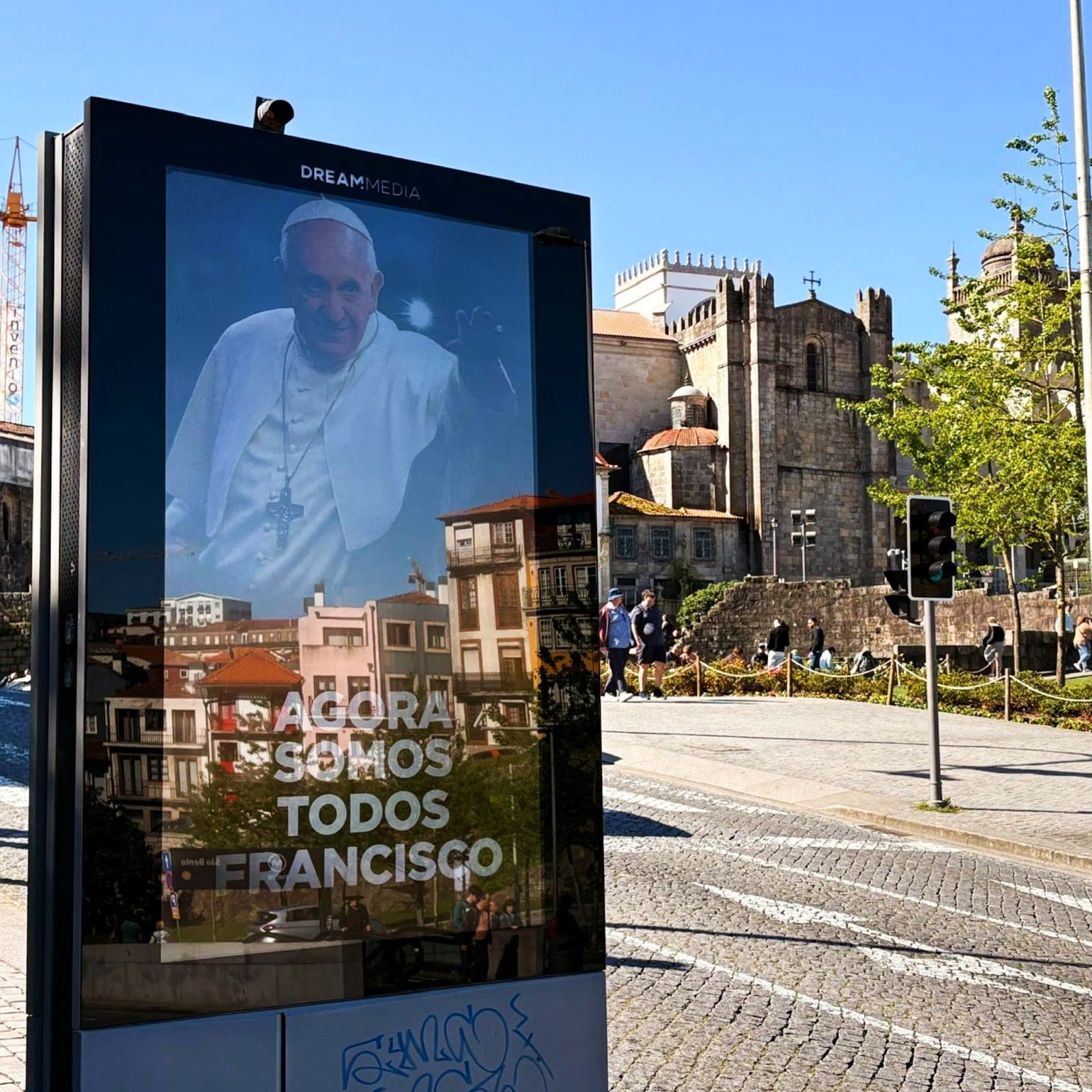
“Agora Somos Todos Francisco,” a sign outside the Catedral Do Porto, Porto, Portugal, with the city reflected. Photo credit: Gerald Schlabach.
“Religion that is pure and undefiled before God and the Father is this: to visit orphans and widows in their affliction, and to keep oneself unstained from the world. James 1:27 (RSV)
https://catholicreview.org/whoopi-goldberg-delivers-sister-act-swag-to-pope-francis/
For your listening pleasure: “Love is Still the Answer,” Jason Mraz.
This is incredible, Holly. You say so beautifully what many of are struggling to express. Thank you! Even though I belong to an independent Catholic jurisdiction, I and all my fellow ANCCers share your admiration, your gratitude, and your grief.
Beautiful, Holly. Thank you. It is difficult for those of us who don't reflexively align with one ideological camp or another to explain why we felt so attached to Francis.